
Pregnant women are considered a part of a vulnerable population that faces many health disparities, especially those living in low income areas. Access to dental care remains the largest barrier to oral health screening in pregnancy. This includes access to dental health care providers. Interventions aimed at increasing provider access should be an important consideration. As a result, alternative models of care need to be developed in response to the shortages of providers. The Institute of Medicine recommends development of a new delivery systems that will expand delivering oral health services and providers through non-traditional modalities (Glassman, Harrington, Namakian, & Subar, 2012) that will directly affect vulnerable populations.
A “virtual dental home” model allows a team of registered dental hygienists and assistants to be stationed in common designated facilities such as (schools, work, community sites) and provide oral health screening and education. This model of care increases access to all populations and reduces health disparities. This team of dental health professionals collect medical and dental health histories, x-rays, and photographs with screening that is uploaded into a secure electronic health system; a collaborating dentist reviews the information via teledentistry and designs a treatment plan (American Dental Association, 2016). Patients who require more extensive dental services are then referred to in-office appointments.
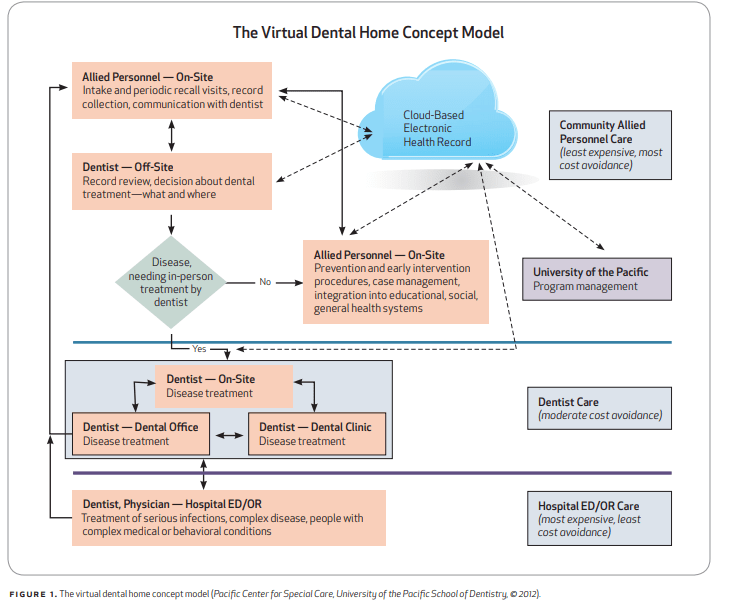
The American Dental Association has endorsed policies in teledentistry since 2015. In Arizona, teledentistry was introduced in November 2009 with five teledentistry providers (Arizona Department of Health Services [AZDHS]). It is interesting that teledentistry has been around for almost a decade. However, its services are not utilized or publicized enough especially for use in pregnant women. According to the AZDHS (2009), barriers in teledentistry surround infrastructure (advisory councils, state leadership, provider retention), policy (developing an agenda), and communication needs (awareness). Under Arizona’s Medicaid AHCCCS program, telehealth services are reimbursable, but it does not apply to teledental services (AZDHS, 2009).

Teledentistry is an innovative policy solution that would alleviate one of the biggest hurdles for oral healthcare in pregnancy: access to care. Teledentistry that is reimbursable under Medicaid may also increase provider services, lower-costs, and provide timely care. In an era where healthcare is rapidly changing, we must take advantage of other modalities to provide care to the undeserved and vulnerable populations. Teledentistry meets this agenda and should be considered in helping pregnant women access dental health and treatment.
References
American Dental Association. (2016). Virtual dental homes offer way to get care to the underserved. Retrieved from https://www.ada.org/en/publications/ada-news/2016-archive/september/virtual-dental-homes-offer
Arizona Department of Health Services. (2009). Teledentistry in Arizona. Retrieved from https://www.azdhs.gov/documents/prevention/womens-childrens-health/reports-fact-sheets/oral-health/teledentistry-arizona.pdf
Glassman, P., Harrington, M., Namakian, M., & Subar, P. (2012). The virtual dental home: Bringing oral health to vulnerable and underserved populations. Journal of the California, 40(7), 569-77.
 Oral Health Care Screening in Pregnancy
Cox Reply to Flores
Kendra, this is a great topic! I believe oral health is vital to our overall health. My doctoral project covers the importance of oral health in the pediatric population. Many people are unaware that oral health is directly linked to systemic health. For my project, I reviewed how poor oral health can impact children, but I had not reviewed the health implications in pregnant women. I found that neonates may be delivered prematurely, as well as underweight due to periodontitis (CDC, 2019). Furthermore, children are three times more likely to have dental caries if their mothers have dental health (CDC, 2019). I am happy to read your blog because I just heard about tele medicine for dental services. I was surprised to hear that dental services could be provided via teledentisrty. At first, I didn’t know how that could be possible, but you explained everything clearly. I think the teledentistry is a great way to get more people oral health care. I know that some dentistry’s are only open during business hours when people are working, and not everyone can take time off work or get a babysitter for a dental visit.
With the use of teledentistry, there is more flexibility, it frees up the dentist for more serious cases, and it ensures more of the community is getting preventative education (ADA, 2016).
Karen
American Dental Association. (2016). Virtual dental homes offer way to get care to the underserved. Retrieved from https://www.ada.org/en/publications/ada-news/2016-archive/september/virtual-dental-homes-offer
Centers for Disease Control and Prevention. (2019). Pregnancy and oral health. Retrieved from https://www.cdc.gov/oralhealth/publications/features/pregnancy-and-oral-health.html
LikeLiked by 1 person
I was completely unaware that tele-dentistry existed until recently; advancements in technology are amazing. Your post was so informative regarding how the gaps in dental care for pregnant women can be closed. Through my blog on maternal mortality I have been reading about the active legislation affecting maternal health. As part of S.B. 1343 Maximizing Outcomes for Moms through Medicaid Improvement and Enhancement of Services (MOMMIES) Act, tele-health services for pregnant women is addressed (March for Moms, 2019). The Act seeks to utilize innovative approaches to health care delivery for Medicaid recipients. This would include tele-dentistry for pregnant women. It also extends Medicaid and CHIP oral health benefits through pregnancy and up to one year postpartum (Children’s Dental Health Project, 2019). This Act could help improve maternal health, which leads to better infant health. It could help eliminate inequities and fill the gaps in dental coverage and access for pregnant and new moms. We must continue to advocate for improved maternal outcomes.
References
Children’s Dental Health Project. (2019). Closing gaps in oral health for pregnant women and new moms. Retrieved from https://www.cdhp.org/blog/648-closing-gaps-in-oral-health-for-pregnant-women-and-new-moms
March for Moms. (2019). Federal legislation. Retrieved from https://marchformoms.org/advocacy/federal-legislation/
LikeLiked by 1 person
Before reading your blog, I have NEVER heard of teledentistry…ever! Not only was I shocked (and excited!) to read about this concept but then to find out it has been around for the last decade?? WOW! After some searching, I was even able to find a coding guide from the ADA to help successfully document these visits (1). They provide a very clear outline as to how to document the difference between synchronous and asynchronous encounters (1). With many advances in our telehealth resources as of late, I have hope that teledentistry policies will be in the future. I noticed in your Week 2 blog you provided a map that highlights states that have emergency, limited, or extensive dental coverage under Medicaid plans. Are you aware of any teledentistry services or virtual dental home models of care in those states that have extensive coverage? I have found in my health policy topic states that have implemented policy change can serve as a foundation for states that have not. I say this because I noticed Arizona is categorized and only providing emergency dental care.
I agree with your thoughts that this is a very plausible way to increase care to vulnerable populations. As an adult-gerontology NP student, I can see how this would be a very beneficial tool to those fragile elders living in long term care, assisted living, or even in their private homes when leaving for an appointment outside of the home is difficult. The ADAs guide even has suggested coding for those visits as well.
References
1. American Dental Association. (2017). D9995 and D9996 – ADA Guide to Understanding and Documenting Teledentistry Events. Retrieved from https://www.ada.org/~/media/ADA/Publications/Files/D9995andD9996_ADAGuidetoUnderstandingandDocumentingTeledentistryEvents_v1_2017Jul17.pdf
LikeLike
This is such an important topic. It is amazing how telehealth has taken off these past few years. With the pandemic crisis, even more so. Our Organization has instituted telehealth for some of our specialty services in a quick fashion to ensure patients continue to get the care they need, as well as protect our patients and community with what the world is dealing with. I am amazed how healthcare has evolved to have such abilities. I never really thought of pregnant women as a vulnerable population, but this has opened my eyes and mind to accept it as such. Teledentistry will certainly address the issue of access to care. American College of Obstetricians and Gynecologists continue to stress the importance of oral health in pregnancy.
Arizona Department of Health Services. (2009). Teledentistry in Arizona. Retrieved from https://www.azdhs.gov/documents/prevention/womens-childrens-health/reports-fact-sheets/oral-health/teledentistry-arizona.pdf
American College of Obstetricians and Gynecologists (2017). Oral health care during pregnancy and through the lifespan. Retrieved from http://www.acog.org/~/media/Committee%20Opinions/Committee%20on%20Health%20Care%20for%20Underserved%20Women/co569.pdf?dmc=1
LikeLike